
Bookkeeping Fundamentals
Build a clear understanding of everyday business records. Explore transaction documents, debit and credit entries, invoices, reconciliations and basic financial reports.
About this course
Reliable business records start with a consistent method. Bookkeeping Fundamentals explains how everyday activities such as issuing an invoice, paying a supplier and receiving a customer payment become organized financial information.
Follow the path from a source document to an account entry and then to a report. Learn the purpose of assets, liabilities, equity, revenue and expenses, and use the accounting equation to understand how transactions affect a business. Introduce debits and credits through straightforward examples rather than memorizing entries without context.
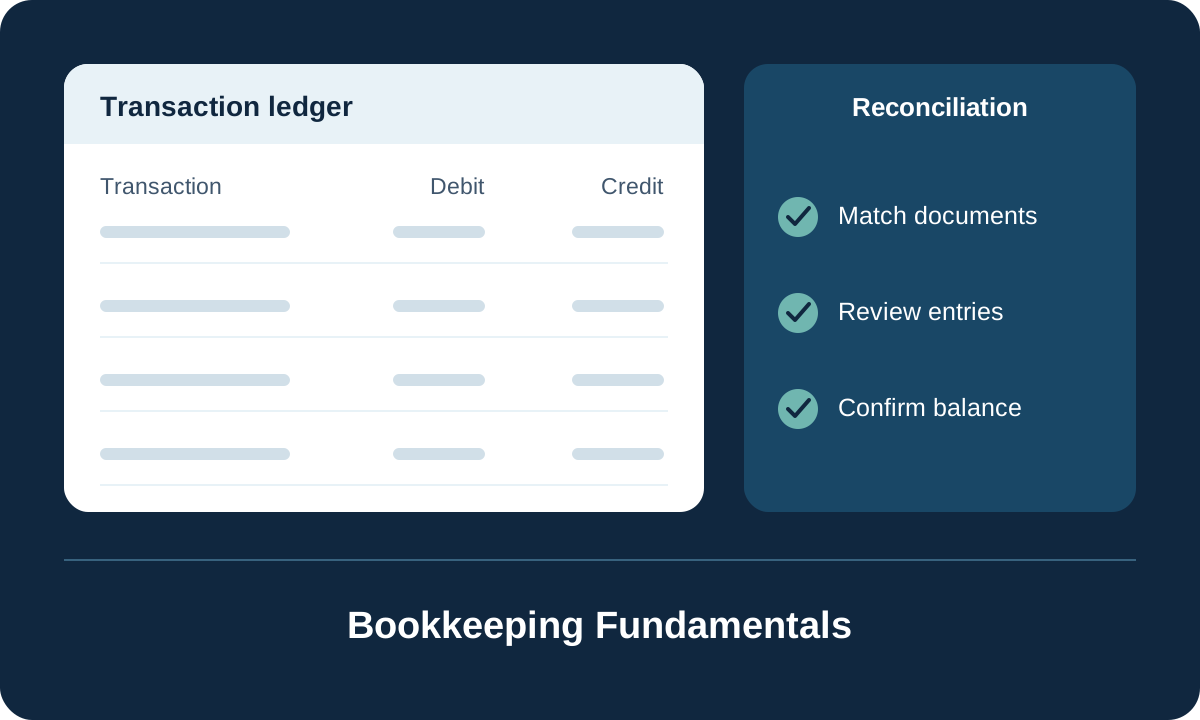
Explore practical routines for keeping records complete: label documents, connect payments with invoices, review unpaid balances and compare the books with a bank statement. The program emphasizes traceability so that another person can understand the evidence behind an entry.
Finish with an introduction to the trial balance, income statement and balance sheet. Understand what each report helps a business review, what information it depends on, and why a balanced set of entries can still contain mistakes.
Who this course is for
This program is intended for business owners, office administrators and learners beginning to work with business records. It also suits team members who handle invoices or expenses and want to understand the wider bookkeeping process.
What you need
No previous bookkeeping study is assumed. You should be comfortable with basic arithmetic and have access to a spreadsheet or a notebook for working through examples. The program is software-neutral and uses US-dollar examples.
Practical focus
Organize sample documents, record a small set of transactions, reconcile a simple bank statement and interpret introductory financial reports. Specific software subscriptions are not required for the foundation topics.
Course details
Check the enrollment terms for confirmed delivery arrangements, access conditions and any completion documentation. This foundation program does not state a professional license, accreditation or tax-preparation qualification.
Core learning areas
Key topics and practical skill areas included in this course or bundle.
Understand invoices, receipts, statements and the evidence needed for an entry.
Relate assets, liabilities and equity to the structure of a business.
Organize accounts and distinguish revenue from expenses.
Work through how a transaction changes accounts using balanced entries.
Track amounts owed by customers and amounts due to suppliers.
Maintain a consistent process for categorizing and retaining business documents.
Compare recorded activity with a statement and investigate differences.
Read introductory income statements and balance sheets and recognize the limits of a trial balance.
Learning outcomes
- Explain how a source document supports a bookkeeping entry.
- Classify common business transactions and apply basic debit and credit logic.
- Connect invoices with payments and review outstanding balances.
- Carry out a simple reconciliation and interpret basic financial reports.
Questions before you enrol
Is the course suitable for beginners?
Yes. The program begins with business documents, account types and straightforward transaction examples.
Do I need a particular bookkeeping application?
No. The foundation topics are software-neutral; a spreadsheet or notebook is enough to work through the examples.
Are US tax returns included?
Tax return preparation and jurisdiction-specific tax rules are outside this foundation program. Examples focus on everyday records in US dollars.
Does this course qualify me for a licensed profession?
This page presents a foundation skills program and makes no licensing or accreditation claim. Check the enrollment terms for confirmed completion documentation.
Get the course details before you decide
Request course information and a FRAMEFORGE LLC advisor can help with study options, payment questions and next steps.